

Mediterranean Revival
The dominant style — 113 of the 281 contributing buildings, roughly 40%. The nomination describes a high concentration of outstanding, high-style examples.
Thinking about a move in Palm Beach County? Let’s talk about your goals. Get in touch
Neighborhood Guide · West Palm Beach, FL
El Cid is a National Register historic district on the Intracoastal in West Palm Beach, about a mile south of downtown — roughly 50 acres of Florida land-boom houses in which Mediterranean Revival predominates.
Reviewed by · Last updated
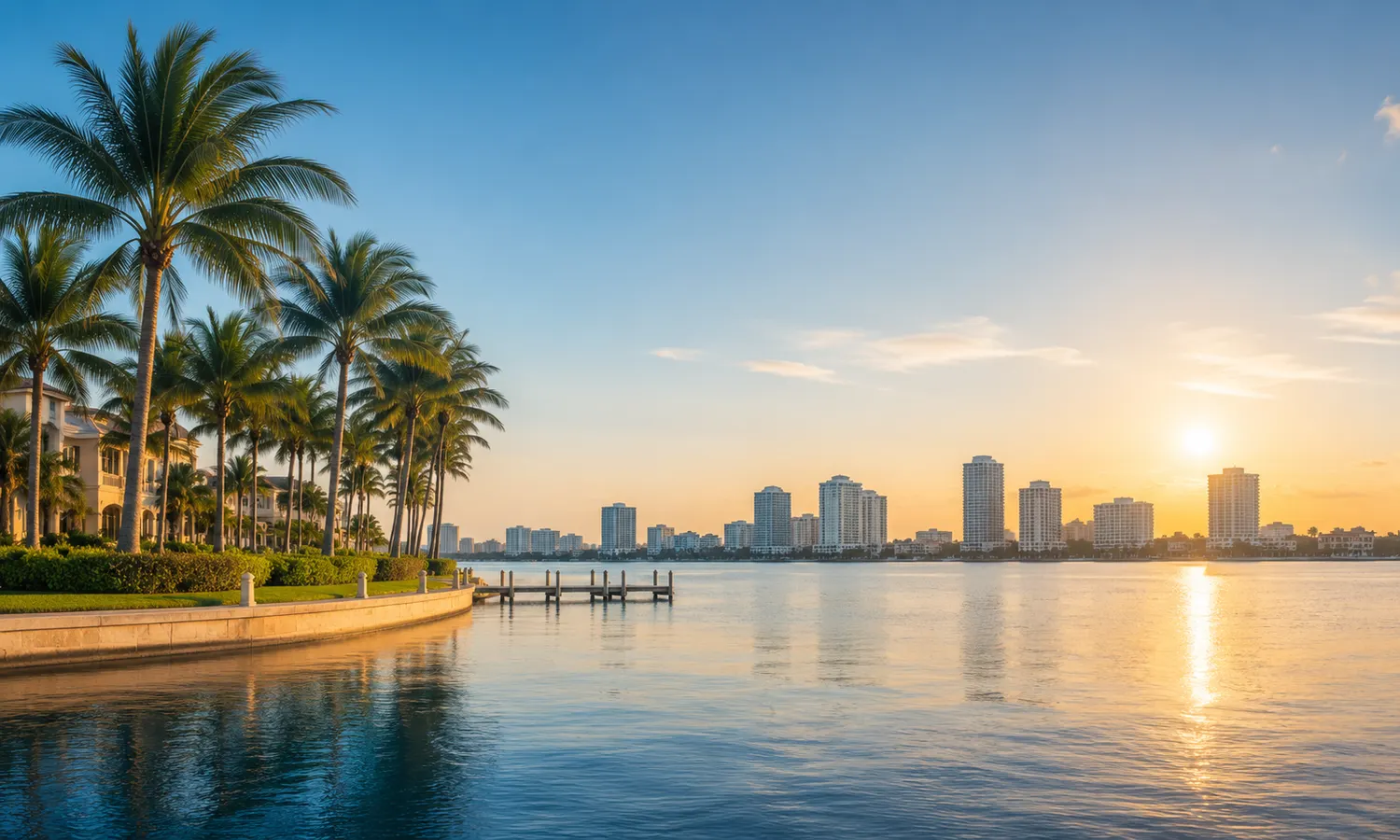
El Cid was listed on the National Register of Historic Places on 31 August 1995 under reference number 95001064, described by the National Park Service as roughly bounded by Flamingo Drive, South Flagler Drive, Dyer Road and South Dixie Highway. The nomination puts the district at approximately 50 acres — worth noting, because several secondary sources repeat a figure ten times that size. It sits about one mile south of downtown West Palm Beach, and it is also a designated historic district under the City of West Palm Beach’s own zoning regulations, which is the designation that actually governs what owners can do.
The district is made up of ten plats, all but one recorded between 1920 and 1928; El Cid North, at the northern end, was filed in 1936. Most of it was developed by the Palm Beach Company, owned by the Phipps family and guided by John S. Phipps (1874–1958), son of Henry Phipps — Andrew Carnegie’s partner in what became U.S. Steel. The El Cid plat itself was filed in 1922. The land beneath it had been homesteaded decades earlier: Benjamin Lanehart (1821–1885) arrived in December 1875 and filed a patent in 1884, while the southern end was originally homesteaded by Elizabeth Wilder Moore.
Building followed quickly. Most of the homes went up between 1923 and 1926, at the height of the Florida land boom, and the majority of the district’s contributing buildings date from 1921 to 1930. The developer’s improvements are unusually well documented: existing lemon, orange and mango trees were preserved, coconut palms were planted along the streets as part of a city-wide programme in 1928, and the West Palm Beach firm of Greynolds and Monroe laid cast-in-place concrete curbs and sidewalks. On the water, the Lake Worth shore was dredged and a concrete seawall with two yacht landings installed. A 60-foot T-shaped private pier, designed by the city engineering department and paid for by El Cid residents, was built in 1920 between Sunset and Valencia Roads; that original pier is no longer standing, though a smaller one occupies the location.
Architecturally the district is dominated by one style. Of the 281 contributing buildings recorded at listing — alongside 96 non-contributing — 113, or roughly 40%, are Mediterranean Revival residences, and the nomination describes El Cid as having a high concentration of outstanding, high-style examples. The remainder is more varied than that suggests: nine pre-1945 Monterey houses, seven Colonial Revival, three Moderne or Art Deco, only two bungalows, and a body of vernacular houses built mostly between 1936 and 1941. Architects named on the nomination include Maurice Fatio, Marion Sims Wyeth, Harvey and Clarke, Belford Shoumate, William Manley King and Bruce Kitchell.
The nomination describes the boundaries precisely: South Flagler Drive forms the eastern edge, running along the west shore of Lake Worth — part of the Intracoastal Waterway; Flamingo Road is the northern edge; Dyer Road the southern; and the western edge follows the rear property lines of the commercial buildings that face South Dixie Highway.
Those boundaries were drawn to follow historic platted streets and subdivision block and lot lines, and were chosen to capture the best concentration of properties retaining architectural integrity from the district’s 1921–1945 period of significance.
Immediately north is the Court Park neighborhood; immediately south, Prospect Park and Southland Park. Downtown West Palm Beach lies about a mile to the north.
The National Register nomination gives an unusually specific picture of the housing stock as documented in 1995. The district is primarily single-family residences with secondary structures — garage-apartments and garages — plus a duplex, a motel and four apartment buildings. Most of the residences are large two-storey houses built between 1921 and 1941, of one or two storeys, built of wood frame or clay tile finished with stucco, on concrete foundations, many with clay tile roofs. Notably, many occupy large double-lot parcels, which is part of why the streetscape feels as generous as it does.
The City’s zoning regulations place El Cid parcels within its historic residential framework, and they distinguish between categories — non-waterfront, waterfront, and a multi-family designation — so the rules applying to a house on South Flagler Drive are not necessarily those applying to one a few streets inland. Confirm the specific designation for any address before making plans.
The single most important thing for a buyer to understand here is the Certificate of Appropriateness process. In a City historic district, actions affecting the exterior of a property — alterations, new construction, demolition and relocation — are subject to review by the Historic Preservation Board or the City’s preservation planners. Board review is the default, though the Board may delegate certain design features to administrative review through an approval matrix. Administrative decisions take roughly 15 working days; Board reviews occur within about six weeks of a complete application, and an applicant may choose Board review over administrative approval. Demolition is handled seriously: applications must be reviewed simultaneously with plans for what would replace the building, the Board may deny demolition where a structure contributes significantly to the district’s historic character, and it may impose a delay of up to three months to explore alternatives. Non-contributing structures over 35 years old in districts surveyed more than five years ago require independent preservation-consultant review.
On price, our position is the same as everywhere on this site: no authoritative public source publishes sale prices for El Cid as a geography. The finest authoritative geography we could verify is Palm Beach County or the wider metropolitan area, which tells you very little about a specific block here. Christian works from verifiable comparables for the particular house and street you are considering, and will show you the source and date behind every figure.
The dominant style — 113 of the 281 contributing buildings, roughly 40%. The nomination describes a high concentration of outstanding, high-style examples.
Nine pre-1945 examples, the earliest built in 1936 at 262 Cordova Road, 192 Dyer Road and 204 Valencia Road.
Seven examples, including the Christian Kirk House at 200 Pershing Way and the Kallman House at 2421 South Flagler Drive (1936).
Three examples: 2631 South Flagler Drive (1937), the Rinker House at 2111 South Flagler Drive (1938), and 285 Barcelona Road (1938).
Mostly built between 1936 and 1941 — typically one storey, often with an integrated garage.
El Cid sits between the water and one of the city’s established retail streets: South Flagler Drive runs along the Intracoastal on its eastern edge, while South Dixie Highway along the western edge carries the Antique Row art and design district.
A School District of Palm Beach County middle school at 3630 Parker Avenue in West Palm Beach.
A School District of Palm Beach County high school at 6901 Parker Avenue in West Palm Beach.
A School District of Palm Beach County school at 7101 South Olive Avenue in West Palm Beach.
An independent, co-educational college-preparatory school on a 54-acre campus at 3151 North Military Trail in West Palm Beach.
An independent school with its Grades 4–8 campus on the island at 241 Seaview Avenue, and its PreK-2 through Grade 3 campus at 1901 South Flagler Drive in West Palm Beach.
An independent, coeducational Catholic school at 807 North Flagler Drive in West Palm Beach, sponsored by the Adrian Dominican Sisters.
School information is provided for reference only and can change. Attendance boundaries, grade levels, and admissions are set by each school and district — confirm details directly with the school. Nothing here is a rating or an endorsement.
No listings in El Cid right now
Authorized listings appear here as they come to market. Christian can also watch this area for you and send matches as soon as they surface.
Facts on this page are drawn from the following sources, accessed as of the date noted.
Let's talk
Schedule a private consultation, view available homes, or get neighborhood market updates as they're published. Christian follows up personally.

Hi, I’m Christian.
Looking to buy, sell, rent or relocate in Palm Beach County? Leave your phone or email and I’ll personally follow up.