

High-rise towers
The tallest buildings in the DDA’s downtown housing directory include two 32-story towers at Plaza of the Palm Beaches, a 21-story building at Two City Plaza and an 18-story building at the St. James Residence.
Thinking about a move in Palm Beach County? Let’s talk about your goals. Get in touch
Neighborhood Guide · West Palm Beach, FL
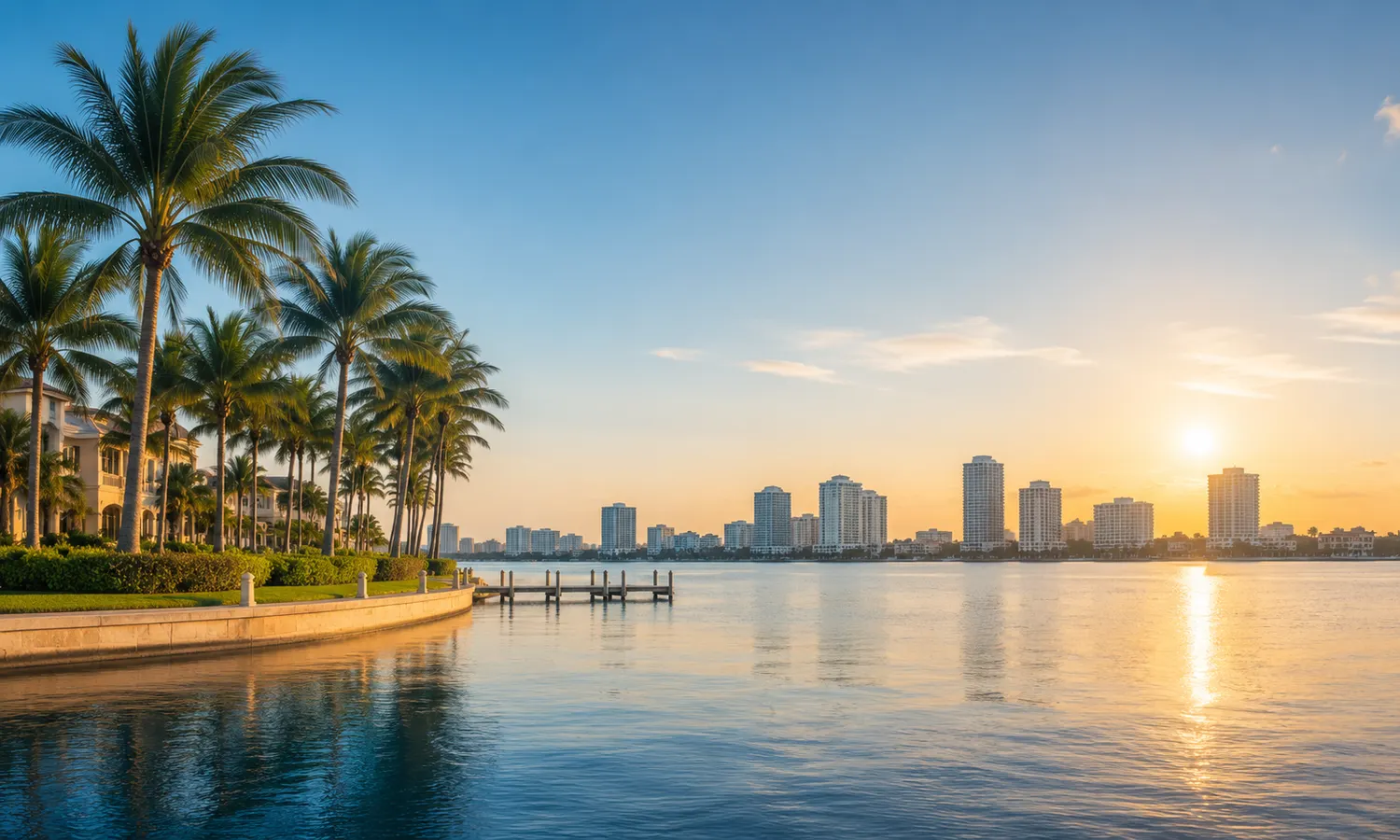
Downtown West Palm Beach is the mainland core of the city, on the Lake Worth Lagoon in ZIP code 33401 — a mid- and high-rise district built around Clematis Street, Flagler Drive and Quadrille Boulevard, and one where the word “downtown” has three different official boundaries.
Reviewed by · Last updated
Before anything else, know that “downtown” is three different places depending on who is drawing the line. The Downtown Development Authority (DDA) district, the City’s Downtown/City Center Community Redevelopment Area, and the Downtown Master Plan zoning area are three separate geographies published by three separate bodies, and none of them matches the way the phrase gets used in property marketing. The distinction is not academic: the DDA boundary determines who pays its millage, the CRA boundary determines redevelopment geography, and the Master Plan boundary determines what can actually be built.
The DDA is the narrowest of the three and the only one with a legal description in statute. It is, in its own words, “an independent special taxing district created by the Florida Legislature in 1967 at the request of downtown stakeholders.” Its charter was codified as Chapter 2003-380, Laws of Florida, consolidating the original 1967 special act (chapter 67-2170) and five later amendments, and section 3 of that charter sets out the downtown area in metes and bounds. It is governed by a seven-member board appointed by the Mayor and ratified by the City Commission, whose members must own — or lease and pay taxes on — real property inside the district.
The Community Redevelopment Agency’s Downtown/City Center district is the broadest. The City describes it as “approximately 940 acres in size with 5 separate target areas included”: the Northwest target area, Brelsford Park/Providencia Park, the Downtown Core, the Clearlake District and the Okeechobee Corridor. The Downtown Master Plan is the zoning geography, and the one that governs development. The City states the DMP “regulates approximately 767 acres,” that the original plan was adopted in 1995 and last updated in 2007, and that an update process was under way as of July 2026. The zoning code describes the plan as “reflective of the downtown’s 13 districts and their different characteristics” — though the City’s own GIS holds fifteen district polygons under fourteen names, so the count depends on which source you read.
On scale, the City publishes a striking before-and-after on its Downtown Master Plan Update page: at the time the original plan was adopted there were “approximately 1,000 residential units downtown and approximately 8,000,000 square feet of nonresidential development,” and “today, there are nearly 9,000 residential units in place and more than 10.4 million square feet of nonresidential development.” The 1995 baseline is firmly dated. The “today” figures carry no date on the page, so treat them as what the City stated when this guide was researched in July 2026 rather than as a current-year count.
Downtown sits on the mainland along the Lake Worth Lagoon, directly across the water from the Town of Palm Beach, and it is in ZIP code 33401. Nothing else: point tests against the Census Bureau’s ZIP Code Tabulation Areas return 33401 throughout the district, and the 33480 that appears when the whole DDA boundary is intersected is the Town of Palm Beach — an artefact of the boundary running out over open water.
The streets that legally define the district are named in the DDA charter’s boundary description: Okeechobee Boulevard, South Dixie Highway, Hibiscus Street, Georgia Avenue, Iris Street, Lake Avenue, Australian Avenue, First Street, Rosemary Avenue, Third Street, Seventh Street, North Railroad Avenue, Eighth Street and North Flagler Drive, along with the Florida East Coast and Seaboard Coast Line railroad lines and the centreline of the Intracoastal Waterway channel. Worth noting for orientation: Clematis Street, Banyan Boulevard and Quadrille Boulevard — the three streets most people name first — are interior streets, not boundaries.
The eastern edge is water. The charter runs the boundary to the centreline of the Intracoastal channel, so the district legally takes in the marina basin; the DDA’s own district map labels the Marina Docks and the City of West Palm Beach public docks on the water side. Flagler Drive, north and south, is the shoreline road for the full length of that edge — the zoning code calls it “the city’s scenic intracoastal waterfront roadway.”
Two bridges to the Town of Palm Beach appear on the DDA’s own district map. The Flagler Memorial Bridge crosses at the north end of the district, landing on North Flagler Drive near Quadrille Boulevard; the Royal Park Bridge crosses at the south end, landing on South Flagler Drive near Okeechobee Boulevard and Lakeview Avenue. We publish no state road numbers, bridge lengths or opening schedules, and nothing about the Southern Boulevard Bridge, because no authoritative source for those was reachable during research.
One historic district sits inside the downtown planning area: the Northwest Historic District, listed on the National Register on 22 January 1992 under reference 91002005 with 316 contributing buildings. It corresponds to the Master Plan’s Northwest Neighborhood District and the CRA’s Northwest target area. Grandview Heights partially overlaps the southern edge of the Master Plan area but falls entirely outside the DDA district.
Downtown is the one part of West Palm Beach where the housing is predominantly vertical. The DDA maintains its own directory of downtown residential buildings, and it is the most reliable answer to the question of which buildings are genuinely downtown: 28 are listed, all with 33401 addresses. Among them are 610 Clematis (251 units), The Whitney at 410 Evernia Street (210 units across nine floors), the St. James Residence at 400 South Olive Avenue (18 stories, 148 units), Plaza of the Palm Beaches at 525 South Flagler Drive (two 32-story towers), Two City Plaza (21 stories), Montecito Palm Beach (16 stories), Esplanade Grande (15 stories), the Harris Music Lofts at 206 Clematis Street (38 units in six stories), The Metropolitan (eight stories) and Evernia Place, a seven-story building for residents 62 and over. The DDA does not state tenure for any of them, so we do not label individual buildings as condominium or rental here — that is a per-building question to answer before you tour.
A correction worth making plainly, because it affects how buildings are marketed: several of the towers most often described as downtown are not inside either downtown boundary. Tested against the City’s own DDA and Downtown Master Plan polygons, the Bristol site (planned development ordinance 4487-13, approved January 2014), the South Flagler House site — recorded in the City’s planned-development dataset as Flagler Towers, ordinance 4987-21, approved January 2022 — and Alba all fall outside both. Alba is roughly three miles north of the downtown core, in the north Flagler corridor. Olara, at a stated address of 1919 North Flagler Drive, does not appear in the City’s planned-development dataset at all and sits north of the charter’s Eighth Street boundary. These are Flagler Drive waterfront buildings north or south of downtown, and that is how this site describes them. One Flagler, by contrast, is confirmed by its developer as a completed 25-story building designed by David Childs of Skidmore, Owings & Merrill.
What can be built downtown is set district by district under Article IV of the zoning code, and the ranges are wide. In the Quadrille Business District — which the code calls “the main office core for downtown, and a link between the city’s two main retail centers: CityPlace and Clematis Street” — base heights run from three stories or 50 feet in QBD-3 up to ten stories or 155 feet in QBD-10, with floor area ratios between 1.00 and 3.50 depending on subdistrict and street frontage. The Clematis Waterfront District runs from five stories or 68 feet up to ten stories or 128 feet, and caps lot agglomeration in its CWD-CD subdistrict at 25,000 square feet, which is why that stretch has stayed fine-grained. The Flagler Waterfront District has a base height of five stories or 68 feet.
Those are base heights, not ceilings. The City maps an incentive system parcel by parcel, and its highest tiers reach 25 stories in the Quadrille Business, Quadrille Garden and Okeechobee Business districts. There is also a transfer of development rights program in the code. But the code itself warns that these “describe maximum development allowances” and that the ability to achieve them “may depend on a number of factors,” including other provisions of the code and the physical characteristics of the site. Treat any height you read as a question for the Planning Division about your specific parcel, not a guarantee.
On price, we publish no figure for downtown, because none that meets our sourcing standard exists. There is no authoritative median or average sale price for downtown, for the DDA district, for the City of West Palm Beach or for ZIP 33401 — the Palm Beach County Property Appraiser publishes no such number, and no days-on-market, inventory, price-per-square-foot or association-fee figure was locatable either. Christian works from verifiable comparables for the specific building and line, and will show you the source and date behind every figure.
The tallest buildings in the DDA’s downtown housing directory include two 32-story towers at Plaza of the Palm Beaches, a 21-story building at Two City Plaza and an 18-story building at the St. James Residence.
A large share of the directory sits between six and sixteen stories — Montecito Palm Beach at 16, Esplanade Grande at 15, The Whitney at nine and The Metropolitan at eight.
Several downtown addresses carry loft names, including the Harris Music Lofts at 206 Clematis Street — 38 units in six stories — along with 101 Lofts and Alexander Lofts.
The DDA lists Evernia Place, a seven-story building for residents 62 and over, alongside Lourdes Noreen McKeen on South Flagler Drive and the St. Andrews Residence on Fern Street.
The downtown zoning districts are written around buildings that combine ground-floor retail or office with residential above; the Quadrille Business District is described in the code as the main office core linking CityPlace and Clematis Street.
Downtown property inside the DDA boundary carries an additional taxing district. The DDA’s charter authorizes a levy of up to two mills, and the Authority publishes a current rate of 0.97 mill — $0.97 per $1,000 of assessed value, illustrated on its own site with a $500,000 condominium paying roughly $485 a year. That rate is undated on the page, so confirm the current millage before relying on it; the two-mill statutory cap is the fixed part. The DDA also states it is authorized to levy a second mill, which has been covered since 2007 through an interlocal agreement with the City’s CRA.
For a sense of direction rather than of price, the Property Appraiser publishes the DDA as its own taxing authority on the county tax roll. Total taxable value inside the district was $4,378,896,905 on the final 2025 roll dated 8 October 2025, and the Property Appraiser’s 2026 estimate dated 1 June 2026 puts it at $4,791,806,771 — a 10.46% increase, of which $223.3 million is net new construction value. That is an aggregate taxable value for a whole district, not a price, a median or a per-unit value, and it should never be read as one.
Because downtown is governed by three overlapping boundaries, verify which ones a specific address falls inside before you assume anything about it — the DDA levy, CRA programs and the Master Plan’s zoning district each apply to different footprints. The City’s Planning Division and the Property Appraiser’s parcel record are the places to confirm it.
Downtown is the most walkable part of West Palm Beach, and the DDA — which is the district organisation, and pays for the daily cleaning, landscaping and wayfinding — puts it this way: many downtown destinations are “within a 10- to 20-minute walk of each other, including Clematis Street, the waterfront, CityPlace, the Brightline station, the Palm Tran Intermodal Transit Center, and nearby dining and entertainment areas.” That is the DDA’s own district-level statement, not a measured door-to-door time, and we deliberately publish no walk or drive times for individual addresses. This site does not license Walk Score, so you will not find one here.
One thing to correct before you plan around it: there is no longer a free downtown trolley. The DDA’s own page states that its trolleys were discontinued beginning 31 May 2023, and its successor service has also ended, with a new City mobility service only anticipated at the time of research. What runs today is described below.
A School District of Palm Beach County high school at 501 South Sapodilla Avenue in West Palm Beach.
A School District of Palm Beach County middle school and arts choice program at 1725 Echo Lake Drive, north of downtown. Admission is by application.
A School District of Palm Beach County middle school at 3630 Parker Avenue in West Palm Beach.
A School District of Palm Beach County high school at 3505 Shiloh Drive, north-west of downtown.
A School District of Palm Beach County elementary school at 1220 L. A. Kirksey Street (the school’s own site writes the address as 15th Street), West Palm Beach.
A School District of Palm Beach County elementary school at 800 11th Street in West Palm Beach.
A School District of Palm Beach County elementary school at 1101 Golf Avenue, West Palm Beach.
An independent school with its Grades 4–8 campus on the island at 241 Seaview Avenue, and its PreK-2 through Grade 3 campus at 1901 South Flagler Drive in West Palm Beach.
An independent, coeducational Catholic school at 807 North Flagler Drive in West Palm Beach, sponsored by the Adrian Dominican Sisters.
A Roman Catholic school at 324 North Olive Avenue in West Palm Beach. Listed here via its federal directory record, as we could not verify an official school website.
An independent school at 307 Evernia Street offering an Orton-Gillingham programme for students with dyslexia.
An independent school at 2001 South Dixie Highway, south of the downtown core.
School information is provided for reference only and can change. Attendance boundaries, grade levels, and admissions are set by each school and district — confirm details directly with the school. Nothing here is a rating or an endorsement.
No listings in Downtown West Palm Beach right now
Authorized listings appear here as they come to market. Christian can also watch this area for you and send matches as soon as they surface.
Facts on this page are drawn from the following sources, accessed as of the date noted.
Let's talk
Schedule a private consultation, view available homes, or get neighborhood market updates as they're published. Christian follows up personally.

Hi, I’m Christian.
Looking to buy, sell, rent or relocate in Palm Beach County? Leave your phone or email and I’ll personally follow up.